

Women’s Health

Women’s healthcare focuses on the unique health challenges and requirements women encounter throughout their lives.
Men and women differ significantly in their reproductive systems, but sexual dimorphism extends well beyond reproduction. Physiological differences between the sexes have been observed across various organs, biological processes, and disease patterns. In addition, the distinct stages of the female reproductive lifespan—including the menstrual cycle, pregnancy, postpartum period, and menopausal transition—can further influence biological function. As a result, biological sex, much like age, genetics, and disease state, plays a role in how drugs or chemicals are absorbed, distributed, metabolized, and excreted by the body.
However, despite documented differences, medical research has historically been biased toward male physiology. Although women now frequently account for up to half of clinical trial participants, the impact of biological sex on drug efficacy and safety are often not sufficiently explored. This leading to a health gap, evident in the infrequent presence of sex-specific information on drug labels.
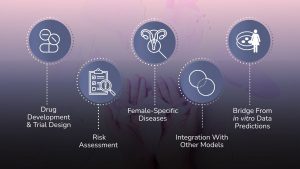
Efforts to account for biological sex in medical research are increasing. PBPK and QSP modeling frameworks enable the integration of sex differences on various levels of detail. Such sex-specific model adaptations can support the investigation of sex-driven variability in drug exposure and response. Furthermore, models that explicitly account for female physiology and anatomy can also provide valuable insights when developing treatments for female-specific conditions.
Physiologically based biopharmaceutics modeling (PBBM) is a specific field of PBPK model applications that aims to establish the link between the formulation’s properties and in vivo performance.
This field of application of PBPK modeling is evolving at a fast-pace and offers the link between in vivo and in vitro to support pharmaceutical development in the selection of the best drug substance and product, as well as later in development in the establishment of manufacturing quality and controls.
Dissolution testing is often a key input in PBBM. Results from in vitro experiments characterizing drug substances and the formulation behavior (e.g., solubility, particle size, dissolution) can be linked to key ADME parameters and integrated into full PBPK models to predict PK exposure in plasma and/or specific tissues or organs.
These models can also be linked to Pharmacodynamic (PD) relationships to derive the impact of physicochemical, drug and formulation properties on safety and efficacy. The role of Physiologically Based Biopharmaceutics Modeling (PBBM) in drug development spans multiple stages, including supporting patient-centric design, guiding life cycle management, informing regulatory submissions, streamlining development processes, optimizing dosing strategies, enhancing study design, and aiding in formulation development and developability assessment.
What we can offer
ESQlabs offers the development of PBPK model extensions that explicitly incorporate female physiology, anatomy, and reproductive life stages. An example for such a model extension is the Female Reproductive Tract PBPK model structure, that we developed with support from the Gates foundation. This model extension provides valuable insights about exposure in the tissues of the female reproductive tract following systems and local drug administration
Watch the video and learn more about our FRT model:
Leveraging our modularized and open-source modeling approach, we can address a broad range of female-specific challenges in drug and chemical development. We are also developing modules for pregnancy and lactation enabling the prediction of changes in maternal exposure due to physiological changes as well as modeling placental transfer and the excretion of chemicals into milk.
Our women’s health platform is continuously evolving, with new model extensions tailored to the unique physiological and pharmacological needs of women. With a flexible and robust modeling ecosystem, we enable sex-specific data analysis to better capture and address female-specific responses and outcomes.
Meet the Team

Nina Nauwelaerts
Nina is a passionate scientist committed to improving the safe and effective use of medicines in vulnerable populations. She holds a Master’s degree in Drug Development from KU Leuven, Belgium and earned her PhD in the Drug Delivery and Disposition group led by Prof. Pieter Annaert, also at KU Leuven. Her doctoral research was conducted as part of the IMI project ConcePTION, where she specialized in developing and applying in vitro and physiologically based pharmacokinetic (PBPK) models to investigate medicine exposure in lactating mothers and their infants.
At ESQlabs, Nina contributes her expertise in PBPK modeling within our Toxicology/PBPK team, with a focus on special populations and advancing research in women’s health.
- Harnessing Open-Source Solutions: Insights From the FirstOpen Systems Pharmacology (OSP) Community Conference
- Harnessing Open-Source Solutions: Insights From the First Open Systems Pharmacology (OSP) Community Conference
- Enhancing PB(P)K Models for the Female Reproductive Tract: A Framework for Local and Systemic Drug Kinetics
Sophie Fischer-Holzhausen
Sophie is a biophysicist dedicated to unraveling the complex interactions underlying physiological processes through mathematical modeling and simulation. She joined ESQlabs in early 2024 as a scientist systems pharmacology.
She earned her Master’s degree in Biophysics from Humboldt University of Berlin, Germany. For her PhD, Sophie joined Prof. Susanna Röblitz’s Computational Systems Biology group at the University of Bergen, Norway, where she helped develop a mechanistic model of menstrual cycle’s endocrine regulation. Prior to joining ESQlabs, she worked as a Pharmacometrician at AstraZeneca in Gothenburg, Sweden.
Sophie is especially passionate about women’s health and leads related initiatives at ESQlabs.

