
One idea drives the evolution of ESQlabs

Few could have guessed how much impact a young cybernetics student named Stephan Schaller would have when Bayer AG asked him to keep glucose levels in effective and safe ranges with high quality. As he absorbed knowledge from pharmacology and applied systems theory, model construction, and predictive control, Stephan became increasingly aware of two things: there was enormous untapped potential – and the key to unlocking it was pre-competitive collaboration.
The status quo was not enough. In 2017, Stephan left a secure job and founded his own company to leverage the success of his diabetes platform for other applications to minimize R&D time. He envisioned a strong quantitative systems pharmacology (QSP) core, built on a physiologically based pharmacokinetics (PBPK) foundation and extended toward clinical decision support systems (CDS). His bold idea: turn it into a modular, interoperable framework for virtually everything – fueled by pre-competitive collaboration.
Keeping concentration levels in effective and safe ranges at high quality quickly crystallized into the defining letters of ESQlabs:
As a bonus, the pronunciation of ESQlabs echoes Aesculap/Asclepius, the Roman-Greek god of medicine – making the name both meaningful and a playful pun.
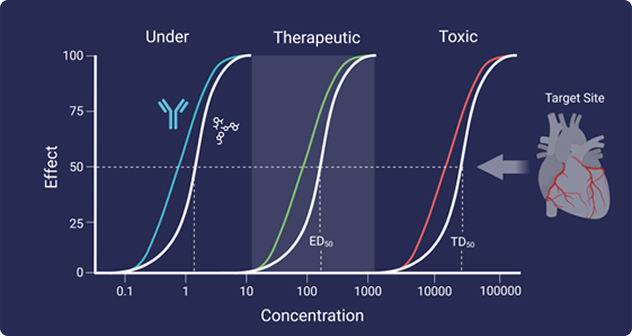
Model-informed drug development (MIDD) was the initial pillar at ESQlabs, and the concept of the therapeutic index became a central source of inspiration – and the company logo. Soon, the company expanded into systems toxicology and next-generation risk assessment (NGRA) for chemicals, and the team’s relentless creativity led to new business units such as MPSlabs for digital twins for microphysiological systems (MPS) and digital-twin-powered science-based apps for your phone.
The journey has just begun, and our clients, partners, and team members continue to shape where ESQlabs goes next.
Our mission, vision, and values


The evolution of our logo: the therapeutic index
The three colors in our logo are inspired by a standard concentration-versus-effect graph used in drug disposition to define the therapeutic range or “index”. The blue zone represents concentrations below the ideal level, where the optimal therapeutic effect has not yet been achieved. The green curve corresponds to the optimal concentration for treatment, indicating the most effective and safe dose for most patients in the population.The red curve represents concentrations above the optimal level, where the dosage starts to exceed what is considered safe. The increasing thickness of our logo circles now symbolize the different dose levels: the blue circle is thinner, the green circle has a median width, and the red circle is thicker to represent a higher-than-recommended dose.
See below how our logos changed over time:



Timeline of events:

