
Earlier this month, for the first time ever, our team ran a four-day intensive training on advanced Physiologically Based Pharmacokinetic (PBPK) and Quantitative Systems Pharmacology (QSP) modeling and simulation. The training centered on MoBi®, one of the key tools in the Open Systems Pharmacology (OSP) Suite together with PK-Sim® — tools whose development the ESQlabs team proudly helps lead as a major contributor, actively driving advances in model-informed drug development (MIDD) and next-generation risk assessment (NGRA).
Five instructors took participants all the way from the fundamentals through advanced workflows, with hands-on practice at every step. By the end, everyone had built a complete model of their own and picked up how to automate their PBPK and QSP workflows using the R-based OSPSuite-R and esqlabsR packages.
Our MoBi ® Summer School brought together ESQlabs colleagues and external participants keen to sharpen their MoBi® and OSP Suite skills, with teams from right across the company in the room: QSP, NGRA, the Large Molecules Platform, PBPK modelers, and more.
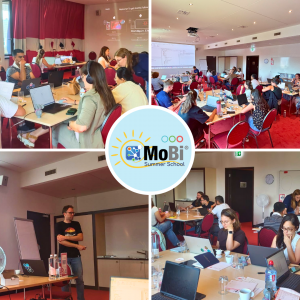
Feedback from participants was strongly positive. Many pointed to the course structure and the hands-on exercises, noting that the training extended beyond MoBi® itself by pairing the tool with R-based workflows, spanning the full PBPK and QSP modeling ecosystem, from model building to parameter identification and sensitivity analysis in R.
Two things stood out most: the debugging sessions, which taught participants not just how to trace an error to its source but that a model can be “wrong” even when no error appears: a real lesson in why systematic model QC matters; and the open-ended final project, built from scratch with no instructions to lean on, which pushed everyone to make and justify decisions that are easy to take for granted with an already-validated model. Together, they left people more confident about extending, adapting, and troubleshooting their own work.
In their own words
A few ESQlabbers told us how the training connected to their day-to-day work.
Candice, NGRA team:
"In the NGRA team, we already rely on publicly available MoBi® modules for dermal and pregnancy PBPK modeling. What this training added was a much deeper understanding of how MoBi® works under the hood: from model structure to equation types and event transports. For my final project I built a mini PBPK model for fish, relevant to environmental toxicology applications like aquatic risk assessment, and I quickly realized just how many details you have to consider when you're building from scratch. I came away with a much clearer sense of how to extend an existing model with confidence, whether that means adding a specific transporter, reaction, or organ-level process to match a new substance."
Courtney, QSP/T team:
"My work centers on the thyroid hormone regulation platform, so I came in with some MoBi® experience already. What this course gave me was a much better understanding of why things are set up the way they are. Working through the R-based workflows alongside MoBi® helped me connect model building with the downstream steps I rely on constantly, like sensitivity analysis, as one end-to-end process rather than separate tools. That really matters for my models, which involve a lot of interconnected feedback loops. Being able to trace an issue back to its real source, means I can make more targeted, informed adjustments going forward, and I'll use again and again as I keep developing the thyroid platform."
Considering the success of our Summer School, plans for a new session next year are already underway. Stay tuned to our LinkedIn for updates!
Interested in building your own PBPK and QSP modeling skills? ESQlabs offers hands-on training, workshops, and one-on-one coaching on the OSP Suite (PK-Sim® and MoBi®). Get in touch to learn more.


