
PBPK for Special Populations:
Pediatrics, Geriatrics, Pregnancy
and Organ-Impairment
Clinical trials involve a limited number of participants and thereby may fall short of adequately representing the diverse range of individuals for whom a drug is intended.
Drug response can vary significantly across populations due to biological, demographic, and environmental differences. Factors like age, anatomy, genetics, disease states, medications, gender, and organ function impact how a drug is absorbed, metabolized, distributed, and excreted, which ultimately affects both efficacy and safety.
Modelling and simulations provide a structured, data-driven approach to assess and predict these variations, allowing drug developers to find the most appropriate dosing regimen or formulation and understand how different populations may respond to a given therapy.
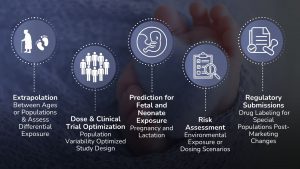
Thanks to physiologically based pharmacokinetic (PBPK) models, ESQlabs enables accurate simulations that support population-specific drug development, providing insights into potential risks and optimizing dosing and trial design for diverse groups.

What we can offer
ESQlabs can simulate physiological and mechanistic aspects of pregnancy, neonatology, pediatrics, geriatrics, intensive care, nephrology, hepatology, diabetology as well as anorexia, obesity, and multiple diseases with potential impact on the pharmacokinetics and pharmacodynamics. We continuously refine, revalidate, and extend our database of population-dependent parameter values and the available populations in that database. To explore the impact of a drug on any population, we use a quantitative approach to account for possible factors that would influence a different response from the typical patient or the so-called healthy volunteer.
Related Platforms

Large Molecules, Biologics and Novel Modalities
Small Molecules and Chemicals

Women’s Health
Related publications and initatives
Meet the Team
Cleo Demeester
Cleo studied Bio-Pharmaceutical Sciences at Leiden University in the Netherlands. Afterwards, she started her PhD research at Bayer in collaboration with KU Leuven, as part of the Marie Curie project AGePOP. Her work focuses on the applicability of PBPK modelling for older adults and adults with obesity. At ESQlabs, she integrates PBPK modelling in the MPSlabs team.

Marco Siccardi
Marco is a Clinical Biologist by training with a PhD in molecular pharmacology and PK/PD modelling. He spent over 15 years at the University of Liverpool working on the topic of pharmacogenetics and in developing PBPK approaches for the optimisation of drug delivery, including HIV therapy optimisation.
Marco has most recently been working with CROs in taking this approaches for modelling and simulation approaches and PKTK (Systems Toxicology) models across a number of disease areas.
Marco leads the Systems Toxicology team with the aim to promote collaborative innovation and to develop novel modeling approaches to streamline the toxicological assessment.
- Development of an end-to-end Quantitative Model-Informed Drug Development (MIDD) ECOSYSTEM
- A review of OSP suite PBBM capabilities: looking ahead
- Roadmap for action for advancing aggregate exposure to chemicals in the EU
- Application of High-Throughput PBPK Modeling to Develop an IVIVE Approach for Oral Permeability
- Enhancing PB(P)K Models for the Female Reproductive Tract: A Framework for Local and Systemic Drug Kinetics
- Advancing Maternal-Fetal and Lactation PBK Models for Cross-Species Risk Assessment in Toxicology
- High-Throughput PBPK Framework in R using Open Systems Pharmacology Software for Anti-Tuberculosis Drug Development

Nina Nauwelaerts
Nina is a passionate scientist committed to improving the safe and effective use of medicines in vulnerable populations. She holds a Master’s degree in Drug Development from KU Leuven, Belgium and earned her PhD in the Drug Delivery and Disposition group led by Prof. Pieter Annaert, also at KU Leuven. Her doctoral research was conducted as part of the IMI project ConcePTION, where she specialized in developing and applying in vitro and physiologically based pharmacokinetic (PBPK) models to investigate medicine exposure in lactating mothers and their infants.
At ESQlabs, Nina contributes her expertise in PBPK modeling within our Toxicology/PBPK team, with a focus on special populations and advancing research in women’s health.
- Harnessing Open-Source Solutions: Insights From the FirstOpen Systems Pharmacology (OSP) Community Conference
- Harnessing Open-Source Solutions: Insights From the First Open Systems Pharmacology (OSP) Community Conference
- Enhancing PB(P)K Models for the Female Reproductive Tract: A Framework for Local and Systemic Drug Kinetics
Raphaëlle Lesage
Raphaëlle, is a Systems Pharmacologist and Bioengineer by training. At ESQlabs, she focuses on applying PBPK and QSP modelling to support drug development, she coordinates the Special Population core service and is particularly interested in modelling special populations to optimize therapeutic strategies, design trials, and prevent unsafe exposure..
Previously, she served as Chief Scientific Officer at the Virtual Physiological Human Institute, where she coordinated scientific working groups in multiple European projects and led stakeholder engagement and regulatory initiatives for advancing in silico medicine.
She studied Bioengineering and Computational modelling for Biology and Pharmacology at Polytech Nice Sophia. She obtained a degree in reseach valorization from UMPC (Paris) and she holds an interdisciplinary PhD in Engineering and Biomedical Sciences from KU Leuven (Belgium), where she conducted research on computational modelling of therapeutic strategies to limit cartilage degeneration or promote bone regeneration.
Sophie Fischer-Holzhausen
Sophie is a biophysicist dedicated to unraveling the complex interactions underlying physiological processes through mathematical modeling and simulation. She joined ESQlabs in early 2024 as a scientist systems pharmacology.
She earned her Master’s degree in Biophysics from Humboldt University of Berlin, Germany. For her PhD, Sophie joined Prof. Susanna Röblitz’s Computational Systems Biology group at the University of Bergen, Norway, where she helped develop a mechanistic model of menstrual cycle’s endocrine regulation. Prior to joining ESQlabs, she worked as a Pharmacometrician at AstraZeneca in Gothenburg, Sweden.
Sophie is especially passionate about women’s health and leads related initiatives at ESQlabs.


