
PBBM for Formulation
Design, Selection and
Quality Control
Design, Selection and
Quality Control
Physiologically based biopharmaceutics modeling (PBBM) is a specific field of PBPK model applications that aims to establish the link between the formulation’s properties and in vivo performance.
This field of application of PBPK modeling is evolving at a fast-pace and offers the link between in vivo and in vitro to support pharmaceutical development in the selection of the best drug substance and product, as well as later in development in the establishment of manufacturing quality and controls.
Dissolution testing is often a key input in PBBM. Results from in vitro experiments characterizing drug substances and the formulation behavior (e.g., solubility, particle size, dissolution) can be linked to key ADME parameters and integrated into full PBPK models to predict PK exposure in plasma and/or specific tissues or organs.
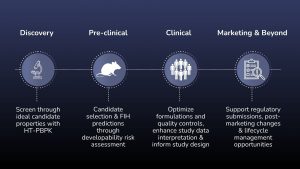
These models can also be linked to Pharmacodynamic (PD) relationships to derive the impact of physicochemical, drug and formulation properties on safety and efficacy. The role of Physiologically Based Biopharmaceutics Modeling (PBBM) in drug development spans multiple stages, including supporting patient-centric design, guiding life cycle management, informing regulatory submissions, streamlining development processes, optimizing dosing strategies, enhancing study design, and aiding in formulation development and developability assessment.

What we can offer
ESQlabs offers to develop, apply and test PBBM models and their integration in formulation-related applications. Our approach can support the development of innovative medicines as well as the development of new generic formulations. Our unique open-source approach can be applied across multiple routes of administrations and formulations at several stages of development, from immediate-release (IR), modified-release (MR), to development of complex formulations such as bio-enhanced technologies (e.g., amorphous solid dispersions (ASD), lipid-based formulations, and others). ESQlabs utilizes the Open systems Pharmacology (OSP) suite. Beyond the PK-SIM® default implementation of oral drugs absorption (1,2,3,4), MoBi® allows extension of models for different type of administration such as ocular, inhalation, dermal, long-acting injectables, and many more. Our advanced modeling approaches can support data-driven decisions regarding strategies for formulation selection and optimization across the drug development cycle.
Related Platforms

Large Molecules, Biologics and Novel Modalities
Small Molecules and Chemicals
Meet the Team

Laurence Dodd
Laurence joins us with a strong background in biopharmaceutics modeling. As a lead developer and consultant for biopharmaceutics modeling software, he focused on improving model performance and designing innovative features. Laurence has worked on a variety of projects, from mechanistic disintegration and surfactant solubilization to advanced models for supersaturating formulations like ASDs.
With a master’s in chemical engineering from UCL, Laurence brings expertise in modeling, simulation, process optimization, and renewable technology.

Marco Siccardi
Marco is a Clinical Biologist by training with a PhD in molecular pharmacology and PK/PD modelling. He spent over 15 years at the University of Liverpool working on the topic of pharmacogenetics and in developing PBPK approaches for the optimisation of drug delivery, including HIV therapy optimisation.
Marco has most recently been working with CROs in taking this approaches for modelling and simulation approaches and PKTK (Systems Toxicology) models across a number of disease areas.
Marco leads the Systems Toxicology team with the aim to promote collaborative innovation and to develop novel modeling approaches to streamline the toxicological assessment.
- Development of an end-to-end Quantitative Model-Informed Drug Development (MIDD) ECOSYSTEM
- A review of OSP suite PBBM capabilities: looking ahead
- Roadmap for action for advancing aggregate exposure to chemicals in the EU
- Application of High-Throughput PBPK Modeling to Develop an IVIVE Approach for Oral Permeability
- Enhancing PB(P)K Models for the Female Reproductive Tract: A Framework for Local and Systemic Drug Kinetics
- Advancing Maternal-Fetal and Lactation PBK Models for Cross-Species Risk Assessment in Toxicology
- High-Throughput PBPK Framework in R using Open Systems Pharmacology Software for Anti-Tuberculosis Drug Development

Mariana Guimarães
Mariana, a pharmacist with a Ph.D. in Biopharmaceutics. During her doctoral research, she worked on developing in vitro and in silico tools with a focus on predicting pediatric clinical outcomes. Mariana brings experience in applying physiologically based biopharmaceutics modeling (PBBM) to upport formulation development and understand oral drug absorption risks.
Before joining ESQlabs she worked at GSK in the Biopharmaceutics team, further applying tools for understanding biopharmaceutics risks in adult and pediatric drug development programs, including but not limited to the understanding of the behavior of formulations through application and development of biorelevant dissolution tests and PBBM
- A review of OSP suite PBBM capabilities: looking ahead
- Application of High-Throughput PBPK Modeling to Develop an IVIVE Approach for Oral Permeability
- Harnessing Open-Source Solutions: Insights From the FirstOpen Systems Pharmacology (OSP) Community Conference
- Harnessing Open-Source Solutions: Insights From the First Open Systems Pharmacology (OSP) Community Conference


